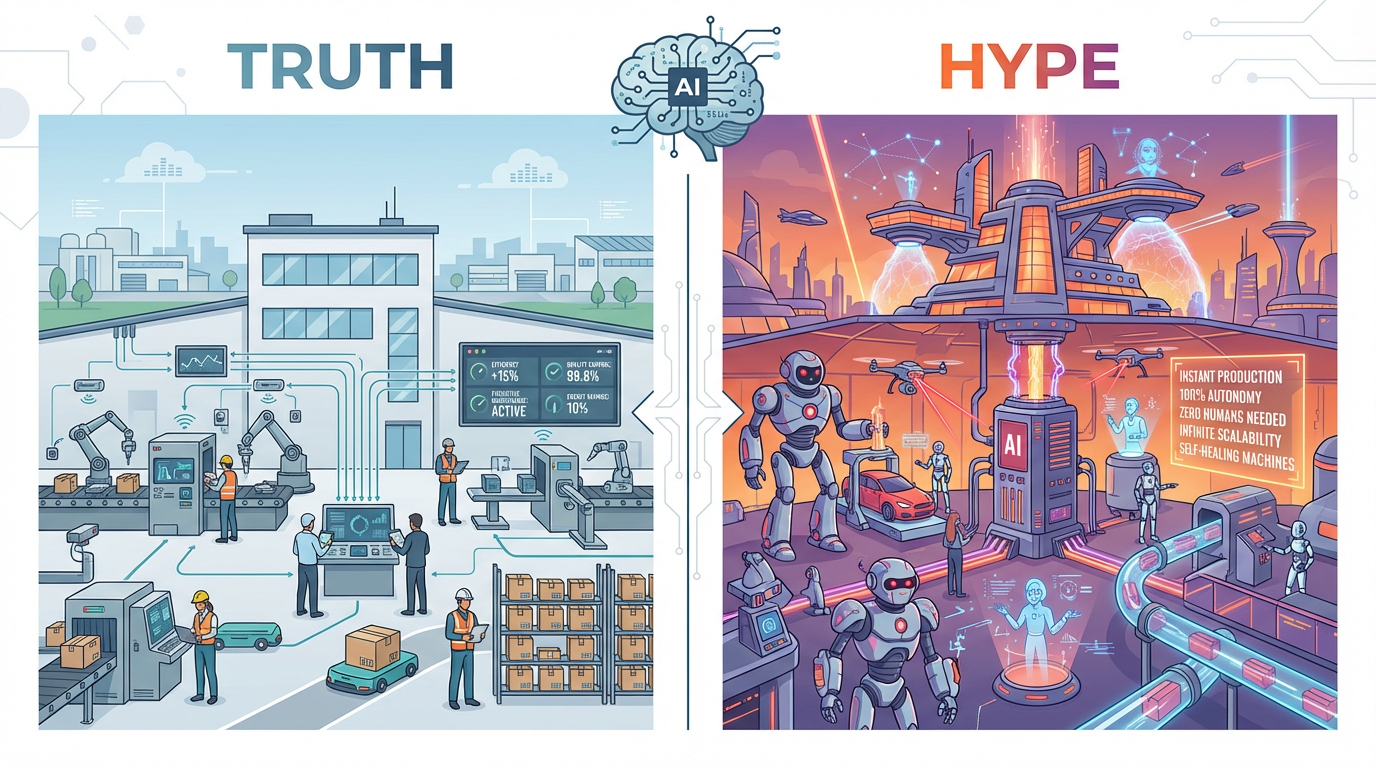
AI in Manufacturing: Separating Science from Snake Oil
"Our AI solution will revolutionize your factory!" The sales pitch was slick. Buzzwords flew: deep learning, neural networks, cognitive automation, intelligent optimization.
The factory owner in Ahmedabad was impressed. "What exactly will it do?" he asked.
"It uses advanced AI to optimize your entire operation."
"Yes, but how?"
"Through machine learning algorithms that analyze patterns and predict outcomes."
"Right, but what specific problem does it solve?"
The sales rep paused. "Well... it depends on your data."
Translation: They had impressive technology looking for a problem to solve. That's backwards.
The AI Hype Cycle in Manufacturing
Here's what typically happens: A vendor reads about AI success at Tesla or Amazon. They build something AI-powered. Then they look for factories to sell it to.
The problem? Tesla's manufacturing challenges aren't your challenges. Amazon's scale isn't your scale. What works for them might be completely irrelevant for a 200-employee factory in Ludhiana.
But the pitch sounds amazing. "AI-powered production optimization" beats "We made your scheduling spreadsheet slightly better."
Same outcome. Different marketing.
Real AI vs. Rebranded Software
Let's get specific. Here's what actual AI can do in manufacturing versus what's just marketing:
Snake Oil: "AI-Powered Inventory Management"
What vendors claim: "Our AI predicts optimal inventory levels using deep learning!"
What it actually is: A decent forecasting algorithm (maybe even just moving averages) with safety stock calculations. Not AI. Just math. Good math, but not AI.
A textile factory paid ₹12 lakhs for "AI inventory optimization." When their IT guy examined it, he found it was using simple seasonal trend analysis. The same logic that Excel's FORECAST function uses. They paid ₹12 lakhs for what Excel does for free.
Real AI: Computer Vision for Quality Control
What it does: Cameras capture product images. Neural networks trained on thousands of examples identify defects—scratches, color variations, dimensional issues—faster and more consistently than human inspectors.
A ceramic tile manufacturer in Morbi implemented this. Training involved showing the AI 50,000 images of tiles—good and defective. After training, accuracy: 98.2%. Speed: 600 tiles per hour versus 120 tiles per hour with manual inspection.
That's real AI. It learned patterns from data that rule-based programming couldn't capture.
Snake Oil: "AI Production Scheduling"
What vendors claim: "Our AI optimizes your production schedule in real-time!"
What it actually is: Constraint-based scheduling with some priority rules. These algorithms existed since the 1980s. Calling it "AI" now doesn't make it new.
Real AI: Predictive Quality Modeling
A pharmaceutical plant had inconsistent batch quality. Sometimes batches failed final testing, but they didn't know why. Multiple variables: temperature, humidity, mixing speed, ingredient batch numbers, operator, time of day.
They implemented ML models that analyzed 2 years of production data—all variables for all batches, both good and failed. The model identified patterns:
- Batches mixed above 28°C had 3.2x higher failure rate
- Ingredient batch from Supplier B correlated with issues
- First batch of the day had better outcomes (cleaner equipment)
These patterns weren't obvious to humans because they involved interactions between multiple variables. The AI found them. Quality failures dropped 67%.
That's real AI—finding non-obvious patterns in complex data.
The Five Questions to Ask Any AI Vendor
1. "What Specific Problem Does This Solve?"
If they can't answer in one clear sentence without buzzwords, walk away.
Good answer: "It identifies defects in welded joints 10x faster than manual inspection."
Bad answer: "It leverages deep learning to create actionable insights through data-driven optimization."
2. "Can You Show Me the Training Data?"
Real AI requires training on relevant data. If they're selling you an "industry-ready solution," be suspicious. Your factory's problems are unique to you.
A vendor sold "pre-trained AI for CNC optimization" to a machine shop. Turned out it was trained on automotive parts data. This factory made agricultural equipment. Completely different materials, tolerances, and issues.
The model was useless. They had to retrain it from scratch—which should have been the plan from day one.
3. "What Happens When It’s Wrong?"
AI isn't magic. It makes mistakes. What's the failure mode?
Quality inspection AI that occasionally misses a defect? Annoying but manageable—you can have random spot-checks.
Production control AI that occasionally gives disastrous recommendations? Dangerous—one bad decision could shut down your line.
Understand the risk. Have human oversight on critical decisions.
4. "How Much Data Do You Need, and Do I Have It?"
ML models need data. Lots of it. If a vendor promises results without discussing your data availability, they're either lying or selling something that's not really AI.
A packaging factory wanted AI to predict maintenance needs. The vendor needed 12 months of historical data: maintenance logs, sensor readings, production volumes.
The factory had 3 months of data, poorly organized, with gaps. Implementing AI would require 9 more months of data collection first.
Honest vendor. Good outcome. They started with simpler condition-based monitoring while building the data foundation for eventual AI.
5. "What’s the Accuracy, and What Does That Mean in Practice?"
"95% accuracy!" sounds great. But what does it mean?
A defect detection AI has "95% accuracy." Your factory produces 10,000 units daily. Normal defect rate: 2% (200 defective units).
95% accuracy means:
- It correctly identifies 190 defects (good)
- It misses 10 defects (bad)
- It falsely flags 490 good units as defective (really bad)
Now you're manually re-inspecting 490 false positives plus those 10 it missed. More work than before AI.
Accuracy isn't enough. Ask about false positive rate and false negative rate. Those determine if AI actually helps or just shifts the work.
When AI Actually Makes Sense
AI is genuinely useful when:
1. The Problem Involves Pattern Recognition at Scale
Visual inspection, anomaly detection, quality prediction—things humans do well but slowly, or things with subtle patterns humans miss.
2. You Have Sufficient Historical Data
At minimum 6-12 months of clean, relevant data. For complex problems, 2+ years.
3. The Cost of Being Wrong is Manageable
AI with 95% accuracy on non-critical decisions? Fine. AI with 95% accuracy controlling equipment that could injure workers? Absolutely not.
4. Humans Can't Scale the Solution
If you could solve it by hiring 2 more QC inspectors, that might be cheaper and more reliable than AI.
The Pragmatic Approach
Before investing in any "AI" solution:
- Define the specific problem in measurable terms (cost, time, defects, waste)
- Try conventional solutions first (better processes, more training, simple automation)
- Only then consider AI if the problem requires pattern recognition beyond human capability
- Start with a proof-of-concept on real data before full implementation
- Measure real-world results, not demo-day metrics
The Bottom Line
AI is a tool. A powerful tool, but still just a tool. It's excellent at specific tasks: image recognition, pattern detection, complex prediction.
It's not magic. It won't "optimize everything" or "transform your factory overnight."
The vendors selling you AI revolution? Most are selling rebranded software with AI stickers.
The ones who can clearly explain what specific problem they solve, what data they need, how accurate they'll be, and what happens when they're wrong? Those might actually have something real.
And sometimes, the right answer is no AI at all. If a ₹2 lakh process improvement solves the same problem as a ₹20 lakh AI system, you don't need AI. You need common sense.
If this helped you see through the noise, share it with another factory owner, COO, or plant head wrestling with the same questions. Forward it on WhatsApp, post it on LinkedIn or X, or print it out for your Monday morning production meeting.
And if they haven't subscribed yet? Point them to thefactoryai.in. Two emails a week, zero fluff.